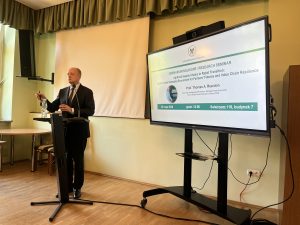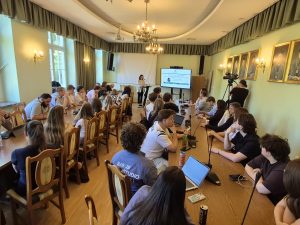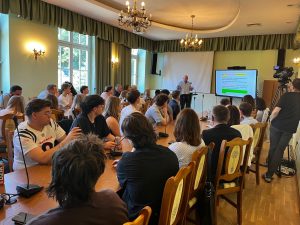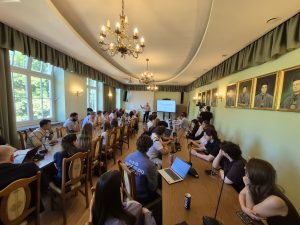
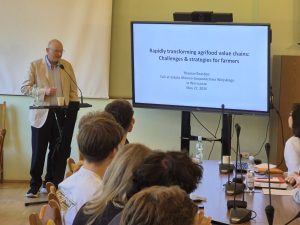
On 26 May 2026, the Institute of Economics and Finance at the Warsaw University of Life Sciences (WULS-SGGW) hosted a research seminar entitled “Agrifood Supply Chains in Rapid Transition: Lessons from Emerging Economies for Farmers’ Futures and Value Chain Resilience.” The guest speaker was Professor Thomas A. Reardon from Michigan State University, one of the world’s leading scholars in the field of agrifood system transformation.
The event was organized by the Institute of Economics and Finance. The seminar was opened by dr hab. Mariusz Maciejczak, prof. SGGW – Director of the Institute of Economics And Finance, who welcomed the participants and introduced the speaker. The session was moderated by dr hab. Agata Malak-Rawlikowska, prof. SGGW.
In his presentation, Professor Reardon discussed the rapid transformation of global agrifood value chains. He highlighted that the modernization process is accelerating worldwide and encompasses retail, food processing, wholesale trade, logistics, and agricultural support services. Particular attention was given to the evolution of procurement systems, the growing importance of supermarkets and e-commerce, and the changing structure of food supply chains.
Professor Reardon emphasized that farmers today face increasing pressure to meet simultaneously the requirements of scale, quality, and cost competitiveness. He argued that procurement decisions made by large retail chains and food processing companies increasingly shape farmers’ opportunities for growth and market inclusion. Drawing on examples from Asia, Latin America, Africa, Europe, and North America, he presented both success stories of producers who adapted effectively to changing market conditions and cases where suppliers lost competitiveness due to insufficient scale, flexibility, responsiveness, or cost efficiency.
The presentation also examined the effectiveness of different strategies aimed at supporting farmers in adapting to modern procurement systems. Professor Reardon highlighted the growing role of specialized wholesalers, new-generation farmer cooperatives, agricultural service providers, and breeding and innovation companies. At the same time, he stressed that support programs and development policies should be designed in close alignment with the actual requirements of modern food supply chains and market demand.
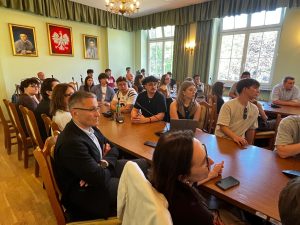
The seminar attracted researchers, doctoral students, and students interested in agrifood system transformation and rural development. The discussion provided valuable insights into the future of farming and the resilience of agrifood value chains in an era of rapid economic and technological change.